Interview: Dante or Die's Terry O'Donovan and Daphna Attias

Updated: Jan 22

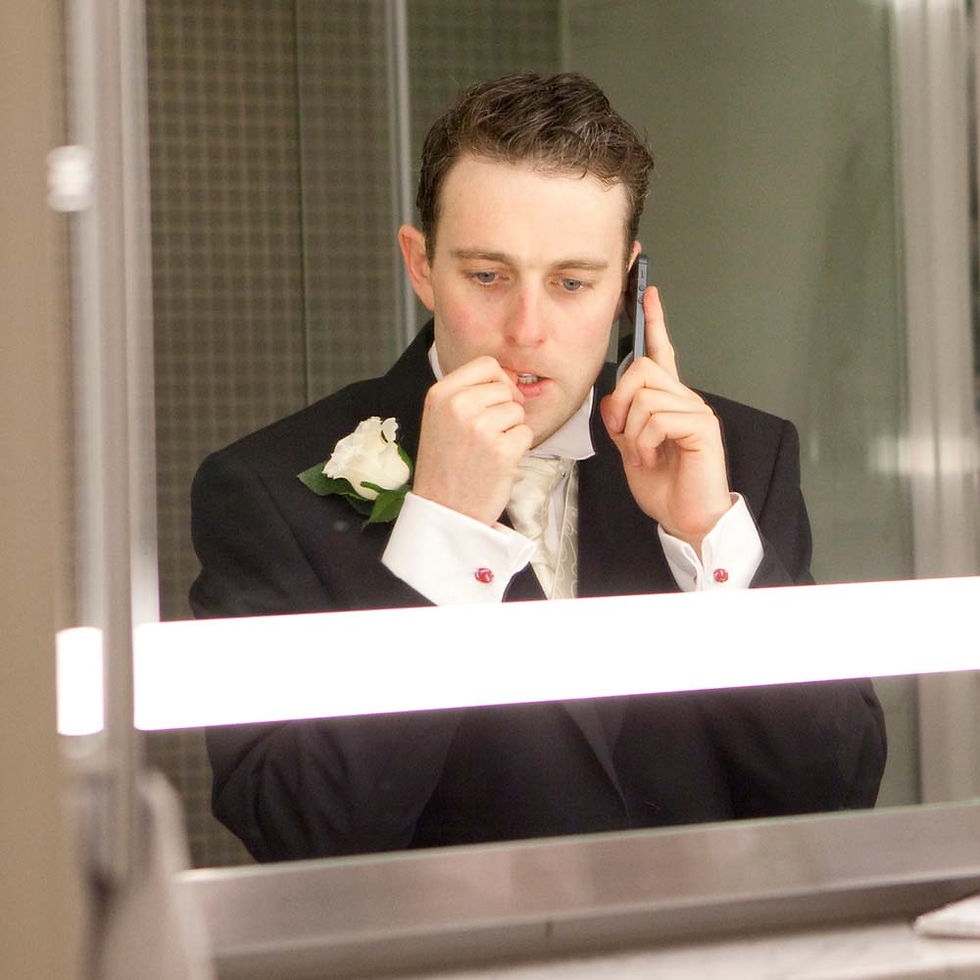
I Do (2013) Photo: Ludovic des Cognets
Later this month, site-specific theatre company Dante or Die will begin a UK tour of I Do, their acclaimed production set across six rooms of a working hotel. Split into small groups, audiences move between rooms, uncovering fragments of a tangled family story as they become voyeurs to a series of intimate, overlapping stories; from old flames and hidden pregnancy tests, to a best man’s speech collapsing under pressure, every glance, touch, and whispered secret counts.
We recently caught up with Daphna Attias and Terry O'Donovan, Dante or Die's Co-Artistic Directors, to discuss the return of I Do, their approach to creating site-specific work, and what the rest of 2026 has in store for the company.
IR: Hi Daphna and Terry. Thanks for speaking with us today! To kick things off, do you mind telling us a bit about Dante or Die’s approach to making work?
Daphna Attias: I don't feel like we have a set methodology. I know the themes that we're interested in, and I know that sites excite us, but we don't have a set way of working, and they can take a lot of different forms. Sometimes they're not even shows, they’re installations or video podcasts or interactive films. We either start with a site or space, which could be a café, a self-storage building or a hotel room, or we start with a topic that interests us, then we take it apart and put it together in a different shape.
Usually, we match the site and the idea. It can also start with an article we read, or with a song that we hear, or with a question that we have about life. The starting point can always be different, but we interrogate questions around it, research around it, experiment with different spaces and where that topic, issue or question lives.
In the case of I Do, it was relationships and weddings. When we created this show 13 years ago, we asked ourselves, ‘Why do people get married?’ It was very personal to us at the time, and we thought about where we could have lots of different types of relationships in a microcosm of exploration. We chose those really tense 10 minutes before a wedding, and we placed it in a hotel where we could meet people in a really intimate, really close space.
Terry O'Donovan: I don't know if it's a methodology, but one thing we always put at the centre of our work is the human within a space or story. It's very much looking at the human existence within something generic like a hotel. Every room that is occupied has a story and emotion behind it all.
It's the same with our screen work, it's anti-Black Mirror in a way. We've gone ‘Where’s the emotion and love within a phone screen?’ How does it affect us emotionally and psychologically? That's one of the things that connects all of our work.
Daphna Attias: Our work for screen is very much us looking at the screen as a site, and our phones as a place we go to. For years, we made shows in real working places, but realised at some point that people's real working places became virtual. It encouraged us to examine those as our sites of work, but it feels like the same process.

User Not Found (2018) Photo: Dante or Die
IR: When you’ve got a physical site for your work, it’s often in real-world spaces. I Do takes place inside a working hotel, and as you said, Daphna, you’ve previously created work set in operating self-storage units, cafes and leisure centres. What is it about these spaces that’s so appealing, over building a set like a lot of other creators do?
Terry O'Donovan: I think that proximity to the actual space and the performers that you encounter within them has a little bit of a trick to it, because you go ‘Is this part of it? Is it not part of it?’ It’s reframing a space that often people might overlook as somewhere that can be filled with story, emotion, connection and magic. If you're in people's local leisure centre, for example, they might go swimming there in the morning, or do aqua aerobics there, and then suddenly they'll see a performance happening in that everyday space. That's something that we really enjoy exploring.
Daphna Attias: It's really strange. When we made Take On Me, there was a scene which involved nudity in the changing room. There's always nudity in leisure centre changing rooms, but it was quite a big deal for audience members, it was like 'What?! One character was naked in the changing rooms!' It's taking a familiar thing and shining a light on it so you see it in a different way, theatricalising an everyday space.

Take On Me (2018) Photo: Richard Budd
IR: As part of your 20th anniversary, you’re remounting I Do, which you debuted back in 2013. Why did that feel like the right piece to revive for this anniversary year?
Daphna Attias: It’s a few things. Firstly, it’s a really joyful show, and we really, really needed a joyful show. We really missed it. We missed the feeling of it. It's like going to visit a familiar house or a familiar person that you haven't seen for a long time.
I Do, for us, was the moment that a few things changed gear. It was when we found the connection between the form, the site, and the story to be the most satisfying. It's the first time we collaborated with a writer, and we were really trying to push a story forward. Before that, I don't think we were as successful in terms of telling a story in such an emotionally resonant way. It’s also a complicated show, and we just wanted to see if we could do it again!
Terry O'Donovan: Yeah, I think what you said about coming back to something that was a gear shift for us as artists is true. We devised the show for a year before Chloë [Moss] came on board. We'd been to the halls of residence at the University of Reading and spent a week there with 12 actors devising and figuring out how this form might work, and we did a sharing of that in Reading Malmaison back in 2012. After that, we said, ‘Okay, it's got the right shape’, but we didn't feel like the dialogue was as sharp as we wanted it to be, and we knew that we could go further.
Lucy Morrison at the Almeida Festival connected us with Chloë, and we presented her with an Excel spreadsheet of like, ‘This is where all the actors need to be at these different times’, because it's all devised based on that. She brought in these other ideas that we would never have thought about in terms of story and brilliant, brilliant dialogue.
It was a really great collaboration that I think pushed us off into another area that we hadn't been exploring as much as before. So when we thought about celebrating something or bringing something back - which we've never done before - we both just said, ‘I Do’.
Video: Dante or Die
IR: How has your relationship with the show changed since it was first created? Do you view it differently now, with another decade of living under your belts?
Daphna Attias: It's been an interesting process for Terry, Chloë and me, because we wanted to keep the essence of the show as it was, but also figure out who we are now and what we want to change. On a really practical level, the world has changed massively. The way we are with technology has changed. The 2013 version had a line that said, ‘Oh, the kids got me an iPhone. Everyone's got one these days,’ and sure - we had dating apps back then - but Tinder was invented the year before, so it wasn't as used as it is now, and there definitely wasn’t such a variety of dating apps. We were also younger, and in the middle or beginning of our relationships. Terry had just got married. I had just given birth to my second child, and Chloë was pregnant when we wrote it.
Terry O'Donovan: Yeah, we were the age of the bride and groom and best man, and now we're between the parents in that group.
Daphna Attias: It changes your perspective on relationships and what's important and what might and might not work. We’ve kept the core of it the same, but we've added a few things that we felt were missing and changed a few things that we felt didn't quite work well enough.
Terry O'Donovan: We've definitely pushed a couple of characters to places that maybe we wouldn't have been able to back then, because we didn't understand that we hadn't lived that life yet. Particularly the father of the bride, that’s a lot meatier than it used to be. There's a pregnancy test involved, and there's a more specific reason for that, and we really thought about that differently.

I Do (2013) Photo: Ludovic des Cognets
IR: For those looking to come to I Do, what role does the audience take on during the show?
Terry O'Donovan: We love playing with an audience. I think I Do is a really fun experience as an audience member, because you’re not asked to do anything. You're literally a fly on the wall. But for us as performers, we’re really in amongst you, and you're kind of implicit within the action despite not being part of it. If anyone's wondering about coming - it's a lot of fun.
IR: You’re currently in rehearsals for I Do with a brand new cast. How has that experience been, and have there been any unexpected discoveries once you’ve been running through it with the cast?
Daphna Attias: It was a really interesting audition process for us, as we had to throw away everything we know about these characters and invite new things into the room. It's always a joy to have a new cast. They have new opinions and new thoughts about things.
We've been doing workshops every morning around how to behave with an audience or how to turn the lights on quickly or how we touch each other in the show. We came a lot more prepared in terms of, ‘Hey, team, this is the language that we're sharing.’ So they then have enough space to be playful within it. Whereas when we made it the first time around, we were inventing it as we were going. I couldn't have done these workshops because I wouldn’t have known what they would be about.
Terry O'Donovan: Yeah, for some of the scenes, you're searching for something that you kind of remember in your body or your mind. It's a question of how do you articulate to these people who weren't around when we did it last time.
I'm sharing the role of the cleaner with a 20-year-old performer in this - it’s her first professional experience. She said to me recently that it was really good to be able to watch me do one section because she could hear Daphne saying something but couldn't imagine it. She said ‘When I saw you do it, I was like, ‘Oh, okay, I get it now.’ But to be able to articulate it would have been really difficult because we found it through devising.
When you find something through devising, you're doing exercises, you're not thinking about what actually has to get done. So then to remount it has real challenges in that way, for that stuff that's not spoken. There's a lot of physicality in the work that may be written on the page, but that doesn't quite lift off the page unless you play with it.

I Do (2013) Photo: Ludovic des Cognets
IR: Finally, looking forward to the rest of 2026, have you got other big plans for Dante or Die’s 20th anniversary once this run of I Do concludes and is in the rearview mirror?
Terry O'Donovan: It’s interesting that you say ‘in the rearview mirror’...
Daphna Attias: Yeah, that’s a good analogy!
Terry O'Donovan: We're making a new piece of work that's for the screen but also an installation. It’s called Driving Home, and it's about migration and immigration in UK towns and cities right now. It's going to be a documentary that includes animation, and we're going to meet five taxi drivers from across the UK, and create a piece that looks at how it feels in the UK right now.
It'll tour as an installation in a black cab, so we'll be blacking out the windows of the cab, be driving it up into the middle of a town or into a shopping centre car park, and people can come in and experience the documentary in an immersive way. The front windscreen will be a close up of a rearview mirror where you see the taxi driver's eyes, and the windows will show the streets of the UK from each of the taxi drivers' places of residence. That's our next big piece. We're going to be filming it in May, putting it together over the summer, and hopefully premiering it sometime in August or September. Funding depedant..
Dante or Die's I Do will run at London Malmaison near Barbican station from 20th January to 8th February 2026, before heading to Reading Malmaison for performances from 11th to 14th January and Manchester Malmaison (Picadilly) from 18th to 22nd February.
Tickets are priced from £35.00 for London, and £25.00 for Reading and Manchester.