

Interview: Dean Rodgers and Tom Black on Alibi: Dead Air

Updated: May 3

Alibi: Dead Air is an immersive murder-mystery experience inspired by Jubensha, a gaming format originating in China that has rapidly become one of the fastest-growing entertainment categories in the world. Blending social deduction, investigative gameplay and live theatre, Alibi places audiences at the centre of an unfolding investigation where no one can be trusted, as they investigate the murder of true crime podcaster Gloria Carpenter.
The experience was recognised as one of No Proscenium's Best Shows of 2025 and later earned a nomination in the 2026 NoPro Audience Awards for best UK-based experience alongside Secret Cinema's Grease, The Key of Dreams and STOREHOUSE.
We recently caught up with the creators of Alibi: Dead Air, Dean Rodgers and Tom Black, to discuss the origins of the show, why Jubensha could be the next big thing in interactive theatre, and how the show's player-driven mechanics create an experience that’s as cerebral as it is social.

Photo: Kiki Tabizel
Immersive Rumours: Hi Dean and Tom. Thanks for speaking with us today. To kick things off, do you mind introducing yourselves and telling us a bit about where people might know you from?
Dean Rodgers: Sure thing. I’m Dean Rodgers, and I'm a creator of immersive experiences. I was a game designer on Time Run, which is regarded as one of the best escape rooms in the UK, but has now sadly closed. I was one of the founders and creative director of The Crystal Maze Live Experience, and I ran a production company called Rogue Productions for a little while, which made a lot of really great escape rooms, including The Perfect Crime. Most recently, I’ve been working in brand experiences, and I've now joined Secret Cinema to help develop their studio arm, Studio Secret Cinema, on the business development and strategy side.
Tom Black: I’m Tom Black; I'm an actor as well as a creator, so people may have seen me if they're immersive theatre fans in things like Crooks 1926 and various Parabolic work, including For King and Country. As a creator, I've made Crisis, What Crisis? with Parabolic, and in lockdown, I put together Jury Games with Joe Ball, Edward Andrews and Ellie Russo, which was a Zoom-based immersive show that’s no longer on Zoom and is now running at Theatre Deli on a permanent basis. I’m currently the Chief Operating Officer at Bridge Command, which I’m pleased to say is getting bigger and more complicated all the time because we’re having a lot of fun there and bringing a lot of people into the immersive theatre world via a sci-fi, gamer route.
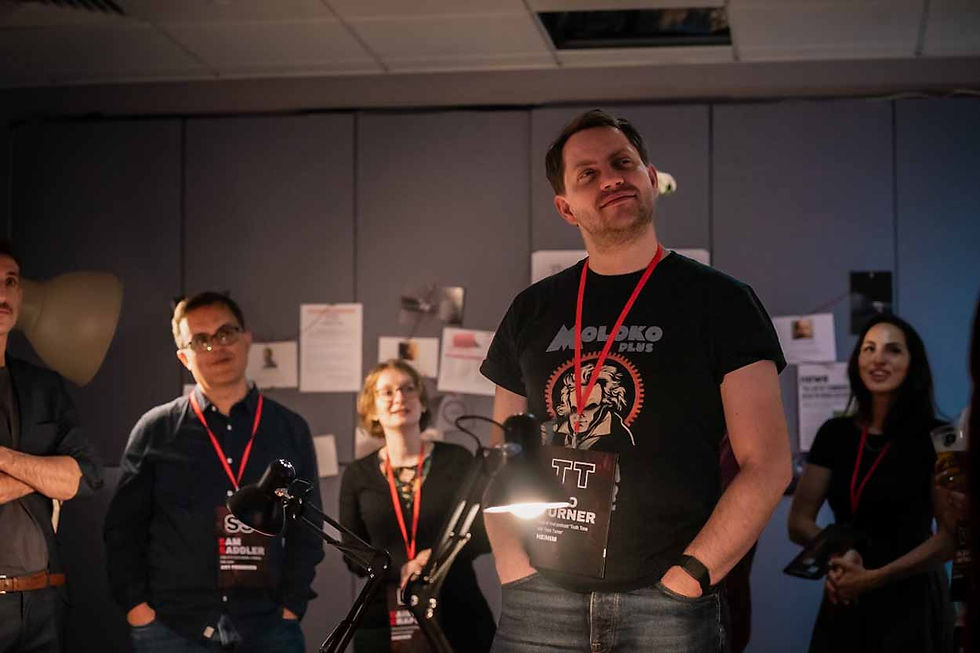
Photo: Kiki Tabizel
Immersive Rumours: Later this month, your Jubensha-like experience, Alibi: Dead Air, is returning to Theatre Deli. What can you tell us about the experience and the audience’s role within the show?
Dean Rodgers: Alibi is a murder mystery experience where you play both suspects and detectives. Dead Air focuses around the death of Gloria Carpenter, a true crime podcaster who’s been following the case of this serial killer called the Malthus Killer. She’s murdered right at the moment of discovering who the killer is, so players are piecing through the evidence she’s gathered, and all of the characters are connected to Gloria or the killer’s murders in some way, and one of you is indeed the killer.
Upon arrival, you're given a little booklet, which explains your character for the experience. I always like to say to people when I give out the booklets that no one is asking you to do any capital ‘A’ acting, but it contains your role within the experience and the things they know. Every character has secrets they're trying to keep, but also things they're trying to discover.
You enter the evidence room, and there are bits of evidence strewn around the room. There’s pieces of paper and a lovely big murder board with strings connecting all the dots, as well as physical clues and audio clues. At that point, our wonderful performer, our detective, tells them there's been a murder, and they need to look around the evidence in the room to discover who the murderer is.
Tom Black: The really exciting thing for me in Alibi is when the players realise that they’re not just there to solve the big crime that's happened, but also to discover things. They all have objectives to do, the other people in the room are trying to find out things about them, and it's all interwoven. Watching people work either together or against each other, and realising that they're going to need to make alliances and swap information with each other, is really fun.
Dean Rodgers: The reality of it is, the vast majority of the evidence is in your fellow players. The game is primarily a social one. It's all about talking to other people, discovering what they know, and trying to figure out who is lying and piece together the answer to this mystery. It gives people a license to talk to strangers. That’s something that’s really fun and really unique about it.
Immersive Rumours: For those who haven’t played one before, can you explain what Jubensha is and how it differs from murder mystery parties, which is probably the comparison most people unfamiliar with Jubensha would make?
Tom Black: The caveat here is that neither of us have been to China and played them, not least because we don't speak Chinese, but Jubensha are typically long experiences that can run anywhere from six to eight hours long. On the surface, they sound like they’re very similar to murder mystery games you might play at a dinner party, and that’s both true and untrue. If you look at the history of them, they’re derived from the same sort of things, with their origin stemming from murder mystery games that came over from France, which later evolved into what Jubensha is now. Jubensha roughly translates to ‘scripted homicide’.
Dean Rodgers: Which doesn’t really roll off the tongue. We need to find a good English name for the genre still…
Tom Black: Within a lot of Jubensha games, you can introduce characters and get to know each other via scripted sections of the game, which is quite unusual in a Western context, as everyone is given an actual script to read. You usually have secrets of your own, you have something you’re all trying to work out, and you’re all interconnected in lots of ways. Imagine Poirot in the train carriage, and everyone is trying to work out what everyone's got to do with each other.

Photo: Kiki Tabizel
Immersive Rumours: What about Jubensha appeals to you both and makes you want to explore creating something in that genre?
Tom Black: Personally, this idea of having a wider mystery, but also everyone having their own thing going on at the same time, is what really drew me to the form. To me, that’s an interesting frontier to be playing in.
Outside of Alibi, I’ve previously made another Jubensha with the wonderful Incog Ltd - which is Hannah Raymond-Cox, Arlo Howard and Chloe Mashiter - called Spy of the Year. You buy it, it comes in a box, and it’s been designed to be played around a dining room table with a few props and people dressing up if they want to. What we’re doing with Alibi is something that’s much more like what you’d see in Jubensha cafes, mashing together Jubensha and immersive theatre.
Dean Rodgers: What really attracted me to Jubensha specifically is that it's an incredibly active player-driven experience where people are really acting and playing and getting to decide how their experience plays out. That, for me, has always been the most exciting thing about immersive theatre. I think the way the immersive experience economy has gone in the last decade, and certainly since COVID, has been away from that and more towards scripted and guided experiences. That’s certainly what I've been doing in my other life at Secret Cinema, and we do that for a reason. It's really popular and really mainstream, but part of me wants to do something for the immersive hardcores who do really want to play.
I’m old enough to remember the beginning of the escape room craze ten or fifteen years ago. For me, where Jubensha is right now feels like that tipping point we were at in 2013, 2014, just before escape rooms became huge. I can see a world in which there are Jubenshas, or whatever we end up calling them, everywhere in the UK and Europe. There’s something really exciting about being on the ground floor of that, having been on the ground floor of the escape room craze as well.

Photo: Kiki Tabizel
Immersive Rumours: Dead Air was previously staged at Theatre Deli last October for a week-long run. What was the response to that initial outing like?
Dean Rodgers: We were really pleased with the audience response for the last run. We had a lot of people come to it who really didn't know what they were coming to and were just coming because they were our friends, but they came out of it saying, ‘I had the best time’, which was really heartwarming.
Tom Black: I’ve made a few things in the past, and one of my friends, who’s seen a lot of them, came out of Dead Air and said, ‘That’s my favourite thing that you’ve done.’ As I mentioned earlier, with how Bridge Command is bringing in that new crowd in unusual ways and through unusual places for immersive theatre, I think this will also potentially do exactly that.
Dean Rodgers: I think what's also really interesting about this is, and again, this is sort of similar to the earlier comments about escape rooms, but it's a very different kind of fun from other experiences. It's not very loud and spectacular in the same way something like Grease or Bridge Command might be, but it's very cerebral and calm and social. You feel like you're just having a lovely night chatting to people, but you’re also trying to solve something.
On a trend side, I do think we'll see a rise in calmer experiences because not everyone wants to go to an escape room and run around. Some people are like ‘Actually, two hours drinking some cocktails and chatting to some people and trying to solve a mystery sounds really nice.’
Immersive Rumours: Did that initial October outing highlight any opportunities to enhance or fine-tune the experience before it returned?
Tom Black: Yeah. With mysteries, they're not hard to test, but you need to test them a lot. There are certain questions you can’t answer until you give it to someone who is, of course, not involved in designing it because they will just think about it differently. I was happy with the ratio of shows where the audience got it right as a whole, or shows where the audience didn’t. It felt like 70:30, which is a pretty good place for it to be. In all the cases where the killer wasn’t identified, it was because the killer played very well and did some clever stuff.
Dean Rodgers: On the changes we've made, there are bits of fine-tuning we've done, but we’ve also changed the length. We were running it as a 90-minute experience in October, and we’re trialling it this time at two hours because we just had a feeling it was a bit of a rush to get everyone to the answers in 90 minutes. In the spirit of testing, that extra 30 minutes might really change the experience.. we don't know.

Photo: Kiki Tabizel
Immersive Rumours: And have you had to tweak any of the core elements associated with Jubensha games to better fit a London audience?
Dean Rodgers: Yeah. One of the key changes we've made is reworking the way you receive your information. In the original Chinese version of Jubensha, you get a booklet at the start of your experience, and you spend about an hour reading your booklet, which has everything you need to know in it. I’ve done enough experiences in London to tell you that there’s no way in a million years you’re getting a London audience to spend an hour reading before they play. No way.
What we've done is taken learnings from the escape room world and given them a little booklet with just their core information in it. The vast majority of the information is hidden around the room, which gets people to move around, get in a corner and talk to one another, and have that not be weird.

Photo: Kiki Tabizel
Immersive Rumours: As you mentioned earlier, Tom, you’ve previously made Spy of the Year. Dean, you’ve also previously created a Jubensha experience, The Crow Club, which was at Voidspace Live last year, right?
Dean Rodgers: Yeah. So, The Crow Club has since evolved into Alibi. It was our very early, work-in-progress version of this that I tested at Theatre Deli two years ago and then presented at Voidspace Live last June. Following that, Tom came on board, and we started transforming it into what is now Alibi.
I think where Alibi is at now, in terms of its lifecycle... We’ve tested it, we’ve R&D’d it, and we’ve run it for a week, so now we’re doing this four-week run to see if it has legs to run for a long period of time. The case is now really polished and fun; we know people enjoy it and have fun with it in ways that we both expected, and surprise us as well, so the next step is seeing if it can stand up for four weeks or longer.
Immersive Rumours: I feel like it’d complement Jury Games really well at Theatre Deli. Hopefully it finds an audience in the way Jury Games has, with it still running some six years on from first launching…
Tom Black: I agree. I think they complement each other, and they’re also very different. As Dean said, the fact that everyone is a suspect and you have secrets you’re keeping from each other and there’s some more game-playing going on makes it a bit more freeform, but if you have fun at one, you’ll also enjoy the other. With Theatre Deli’s great model of having spaces that fit twelve people nicely, there’s potentially a lot of room for the future there.
Immersive Rumours: In terms of replayability, could people play Dead Air more than once, or does it lean more towards only being experienced once?
Tom Black: We had this one with the October run, right, Dean? We had a person come back... Basically, the answer is not massively, but if you weren’t the killer and you come back, playing it again as the killer would be a very different experience, and it wouldn’t matter that you knew the answer, as the killer is the one person who already knows the answer. That’s what we’d say.
Dean Rodgers: Yeah. Dead Air is replayable in the sense that if someone wants to come back and be the killer, that’s something we encourage, but also the hope is that there’ll be many, many Alibi cases in the future.
We wanted to really get Dead Air right before doing another case, but the hope will be that in a few years' time, there’ll be multiple different cases, so you can go ‘Sure, I’ve played Dead Air before, but what about this one or this one?’, and they’ll be different genres and different stories.
Alibi: Dead Air runs at Theatre Deli near Aldgate East from 22nd April to 16th May 2026. Tickets are priced from £35.20. For more information and to book tickets, visit alibi.london


